

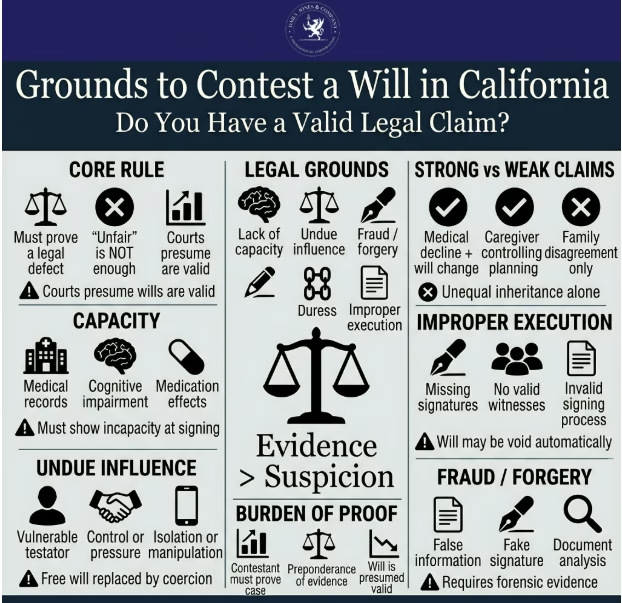
The most important thing to understand before pursuing a will contest is this: feeling that the outcome is wrong is not a legal ground. A will cannot be overturned because a family member feels they deserved more, because a sibling received a larger share, or because the result conflicts with what the deceased said they intended. California probate courts require a specific, provable legal defect — and the burden of proving it falls on the person bringing the challenge.
That distinction separates the majority of disappointed heirs from those with viable legal claims. If the circumstances surrounding a will involve a testator who was mentally impaired, manipulated, deceived, or coerced, the situation may be different. The Daily Jones and Company’s fiduciary abuse and trust litigation practice helps clients answer exactly this question — contact the firm for a free consultation before the probate window closes.
Suspicion vs. a Legally Valid Claim
Recognizing the difference between something that feels wrong and something that qualifies as a legal ground is the starting point of any honest case evaluation. The table below reflects how common concerns map to potential claims — and why the facts behind them matter more than the feeling.
| What you observed | Potential legal ground |
| Caregiver suddenly inherits everything | Undue influence |
| Parent had severe dementia near signing | Lack of testamentary capacity |
| Signature looks different from others | Forgery |
| Will changed dramatically weeks before death | Undue influence or fraud |
| Witnesses were not present at signing | Improper execution |
| Testator was threatened into signing | Duress |
None of these observations automatically creates a viable claim — but each points toward a recognized legal ground that, if supported by evidence, a probate court can evaluate.
Lack of Testamentary Capacity
California Probate Code § 6100.5 sets a four-part threshold: at the moment of signing, the testator must have understood that they were creating a will, the nature and extent of their property, who their natural heirs are, and how the distribution they were making would affect those heirs. The standard is deliberately modest — courts do not require sharp cognitive function, only basic understanding of those four things at that specific moment.
This is why a dementia diagnosis alone does not void a will. Courts assess capacity at the exact time of execution, not through general medical history. A testator with advancing Alzheimer’s may have had a lucid interval during signing; a testator with no diagnosis may have been severely impaired by medication.
As the National Institute on Aging notes, cognitive function can fluctuate significantly in later-stage dementia — which is precisely why physician notes, cognitive evaluations, and caregiver records from the period immediately surrounding the signing date are the most critical evidence in these cases.
Undue Influence
Undue influence is the most litigated will contest ground in California, and the most frequently misunderstood. It does not mean persuasion or a family member advocating for themselves. It means the application of pressure so coercive that the testator’s free will was effectively replaced by someone else’s.
California Welfare and Institutions Code § 15610.70 evaluates four statutory factors: the testator’s vulnerability, the influencer’s authority or control, the tactics used, and whether the result is inequitable.
California also recognizes statutory presumptions of undue influence under California Probate Code § 21380 in relationships involving care custodians, fiduciaries, and individuals who drafted the instrument and stand to benefit from it. When these presumptions apply, the burden shifts — the will’s proponent must disprove undue influence, not the contestant prove it.
The DOJ Elder Justice Initiative identifies caregiver isolation, financial control, and secretive document execution as the core behavioral patterns courts examine in elder exploitation claims.
Fraud, Forgery, and Duress
Fraud
Fraud applies when the testator was deceived about what they were signing or about material facts that shaped their estate planning decisions. A common example: a family member falsely tells an elderly testator that another heir has died or has no need for support, influencing the distribution. The deception must be intentional and must have directly caused the will’s terms.
Forgery
Forgery involves a fabricated signature or document. These claims require forensic evidence — handwriting analysis comparing the disputed signature against authenticated prior examples, expert testimony on document authenticity, and records of who had physical access to the instrument before and after execution.
Duress
Duress applies when the testator signed under direct threat or coercion. Evidence typically involves witness accounts of the relationship dynamic, communications documenting threatening behavior, and medical records showing the testator’s vulnerability during the period of alleged coercion.
Improper Execution
California Probate Code § 6110 requires that a standard will be signed by the testator and witnessed by at least two people present at the signing who understood they were witnessing a will. A document that fails these formalities is legally invalid regardless of its contents or the testator’s intent. Evidence typically comes from the signing ceremony itself — the drafting attorney’s notes, the witnesses’ accounts, and any inconsistencies in how the event was documented.
California also recognizes holographic wills — entirely handwritten and signed by the testator, with no witness requirement — but these remain fully subject to capacity, undue influence, and authenticity challenges.
Weak Claims vs. Strong Claims
The most honest service this article can provide is helping readers distinguish situations where a contest is likely viable from those where the facts don’t support one.
Potentially stronger claims:
- Late-stage dementia documented by treating physicians within weeks of execution
- A caregiver or new confidant who arranged the signing, was present during it, and stands to inherit the bulk of the estate
- A dramatic, unexplained departure from a consistent long-term estate plan
- Forensic evidence of signature discrepancies
Potentially weaker claims:
- Disappointment over an unequal distribution with no evidence of legal defect
- Vague family suspicion without documentation
- Verbal promises the deceased made that conflict with the written will
- A sibling receiving more without any indication of manipulation or incapacity
Under California Probate Code § 8252, the contestant bears the burden of proof. Courts rule on evidence, not family grievances — which is why an honest evidentiary assessment is the right first step before committing to litigation.
No-Contest Clauses and the Risk of Filing
Many wills include a no-contest clause designed to disinherit beneficiaries who challenge the document and lose. Under California Probate Code § 21310, these clauses are enforceable — but California protects beneficiaries who file with probable cause from disinheritance even if their challenge ultimately fails. Probable cause means a reasonable, evidence-based belief in the contest’s merit at the time of filing. A well-grounded claim carries manageable risk; a challenge filed without it can cost a beneficiary their entire share.
Speak with a Probate Litigation Attorney About Your Situation
The question “do I have a claim?” is almost always an evidence question. James Daily and the litigation team at The Daily Jones and Company have spent more than 30 years evaluating and litigating will contests, fiduciary abuse matters, and trust disputes — including cases involving elder exploitation, suspicious amendments, and forged documents.
If the circumstances surrounding a will in your life match any of the grounds above, contact the firm for a free consultation to get a candid assessment of whether your situation rises to a viable legal claim.
Frequently Asked Questions
Can you contest a will simply because it feels unfair?
No. California probate courts require a specific, legally recognized ground — lack of capacity, undue influence, fraud, forgery, duress, or improper execution. A will that distributes assets unequally, or differently than a family expected, is not invalid on that basis alone. Courts presume a properly executed will is valid and will not overturn it based on emotional disagreement.
What qualifies as undue influence in California?
Undue influence under California Welfare and Institutions Code § 15610.70 requires showing the testator was vulnerable, the influencer had authority or control over them, specific tactics were used to override the testator’s free will, and the resulting distribution is inequitable. Persuasion and advocacy are not undue influence — the pressure must have been coercive enough to replace the testator’s independent judgment.
Can a caregiver legally inherit from someone they cared for?
A caregiver can be named as a beneficiary, but California Probate Code § 21380 creates a presumption of undue influence when a care custodian is named as a donee in a document they helped procure. In those cases, the burden shifts to the caregiver to prove the gift was not the product of manipulation. A large inheritance to a caregiver accompanied by late-life estate plan changes and isolation from family is exactly the pattern courts scrutinize most closely.
What if there is no direct proof of manipulation?
Circumstantial evidence is sufficient in California will contests. Probate courts regularly evaluate patterns — isolation, sudden dependency, abrupt estate plan changes, beneficiary involvement in drafting — and draw conclusions from them. A coherent, well-documented pattern of circumstantial evidence is often more persuasive than a single piece of direct proof.
What is the strongest evidence in a will contest?
Medical records from near the signing date, prior wills showing a consistent estate plan that changed dramatically, attorney drafting notes, communications documenting the influencer’s role, and neutral third-party witness testimony are consistently the most persuasive forms of evidence. Neutral witnesses — physicians, financial advisors, or neighbors — carry particular weight because they have no financial stake in the outcome.
Can a will be contested if the testator had dementia?
Yes, but a dementia diagnosis alone is not enough. Courts assess testamentary capacity at the specific moment of execution under § 6100.5. The relevant evidence is what was happening cognitively on the day the will was signed — physician notes, cognitive evaluations, caregiver observations, and medication records from that period — not the general trajectory of the disease.
How do courts decide will contests?
Courts evaluate whether the contestant has established their legal ground by a preponderance of the evidence — more likely than not. They review documentary evidence, hear witness testimony, consider expert opinions on handwriting or cognitive function, and assess the credibility of accounts about the testator’s condition and relationships. Judges do not rule on fairness; they rule on whether a legally recognized defect has been proven.


