

California law permits will contests only when specific legal grounds exist, specific procedural requirements are met, and the person filing qualifies as an interested party under the California Probate Code. Feeling that a will is unfair or that a sibling received more — none of these constitute legal grounds. Courts begin from a presumption that a properly executed will is valid, and that presumption can only be overcome with evidence.
If you believe a will fails California’s legal standards, The Daily Jones and Company offers free consultations to assess whether a contest is viable before the probate window closes.
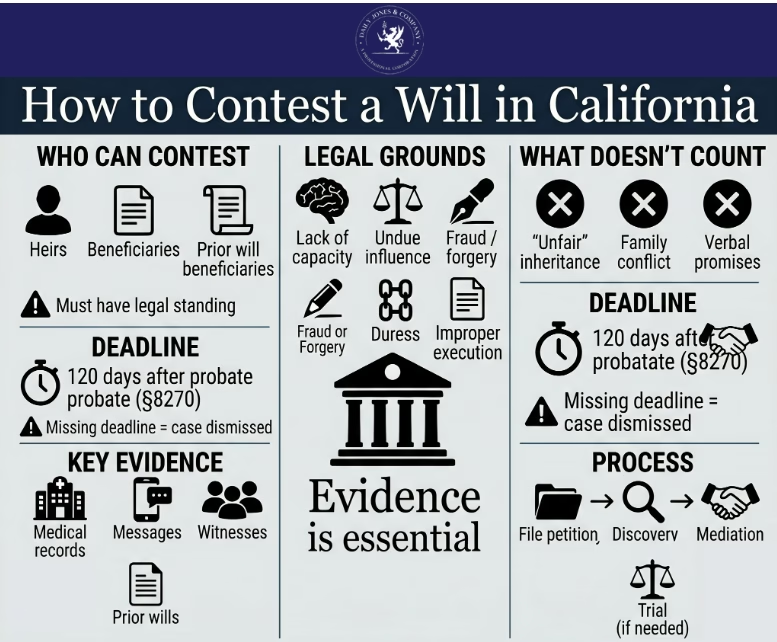
Who Has Legal Standing to Contest a Will?
Not every family member — and not every person who feels wronged — has the right to file. California limits will contests to “interested persons,” defined under California Probate Code § 48 as parties with a financial stake in the outcome. That typically includes:
- Heirs who would inherit under California’s intestate succession laws if the will were invalidated
- Beneficiaries named in the current will
- Beneficiaries named in a prior version of the will who would receive more if a later amendment or will were set aside
- Creditors of the estate in limited circumstances
A person who would receive nothing regardless of the contest’s outcome lacks standing. Courts will dismiss petitions filed without it, regardless of the merits of the underlying claim.
Valid Legal Grounds Under California Law
Lack of Testamentary Capacity
California Probate Code § 6100.5 requires that at the moment of signing, the testator understood what a will does, the nature and extent of their property, and who their natural heirs are. Courts assess capacity at the exact time of execution — not a testator’s general medical history or prior diagnoses. A dementia diagnosis does not automatically void a will; physician notes, cognitive evaluations, and caregiver records from the period surrounding the signing are what matter.
Undue Influence
California Welfare and Institutions Code § 15610.70 defines undue influence through four factors: the testator’s vulnerability, the influencer’s authority or control, the tactics employed, and whether the resulting distribution is inequitable.
California also recognizes presumptions of undue influence in certain relationships — including care custodians, fiduciaries, and people who drafted the instrument and benefit from it — which can shift the burden of proof to the will’s proponent. The U.S. Department of Justice Elder Justice Initiative identifies caregiver isolation and financial control as the most common patterns in elder testamentary exploitation.
Fraud and Forgery
Fraud requires showing the testator was deceived about what they were signing or about material facts shaping their decisions. Forgery requires proving the document or signature was fabricated. Both grounds typically require forensic evidence: handwriting analysis, expert testimony on document authenticity, and records of who had physical access to the instrument.
Duress and Improper Execution
Duress applies when the testator was coerced into signing under threat. Improper execution is a procedural ground: under California Probate Code § 6110, a valid will must be signed by the testator and witnessed by at least two people present at the signing who understood they were witnessing a will. A document that fails these formalities is invalid regardless of its contents.
California also recognizes holographic wills — entirely handwritten and signed by the testator, with no witness requirement — but these can be challenged on capacity, undue influence, and authenticity grounds just like any other will.
What Does NOT Qualify as Grounds
California courts hear only legally recognized grounds. A contest cannot succeed because:
- The distribution feels unfair or unequal
- A sibling or other family member received a larger share
- The testator’s verbal intentions differed from what was written
- The contestant expected to inherit more based on past conversations
- Family conflict makes the will seem inappropriate
Courts are explicit on this point. Emotional disagreement, however sincere, does not meet the evidentiary standard required to overturn a will.
California’s Deadlines for Contesting a Will
Before Probate Admission
Before the court formally admits a will, an interested person can file a petition objecting to admission. This is the stronger procedural position — a successful pre-admission objection can prevent the will from entering probate entirely. There is no fixed deadline for this window beyond the date of the admission hearing.
After Probate Admission
California Probate Code § 8270 sets a 120-day window from the date the court admits the will to probate. This deadline is jurisdictional — courts have no authority to hear a contest filed outside of it, regardless of the evidence or the merits. Missing it permanently ends the right to challenge the will.
Once probate closes and assets are distributed, recovery is rarely available through a will contest.
Filing Requirements and Probate Procedures
A will contest begins with filing a petition in the probate court where the estate is being administered. Under California’s probate court procedures, that petition must state the contestant’s standing, identify the legal grounds, and request the appropriate relief. From there, the case follows a litigation timeline:
- Petition filed and served on all interested parties
- Discovery phase — depositions, subpoenas for medical and financial records, expert witness disclosures
- Mediation — many probate disputes resolve here, particularly when evidentiary positions are clear
- Trial — if unresolved, the court holds a hearing and issues a ruling based on the evidence presented
Most will contests that proceed past discovery settle before trial. Cases with strong contemporaneous medical records or documented patterns of financial control tend to reach resolution faster.
Burden of Proof
Under California Probate Code § 8252, the contestant bears the burden of proving their grounds by a preponderance of the evidence. The starting presumption is validity — the contestant must affirmatively overcome it. In cases where a statutory presumption of undue influence applies, the burden shifts to the will’s proponent to demonstrate the absence of improper influence.
This allocation matters practically. A contestant with insufficient evidence will lose even when manipulation may have occurred. Courts rule on proof, not probability.
Evidence Required to Support a Contest
The evidence required depends on the ground being pursued. For capacity challenges: physician notes and cognitive evaluations from near the signing date, caregiver records, and medication logs. For undue influence: prior wills showing a consistent estate plan, financial records showing transfers or account changes, caregiver access records, and communications between the testator and the alleged influencer. For fraud or forgery: handwriting analysis, document forensics, and records of who had access to the instrument.
The National Institute on Aging and CDC elder abuse research both document the behavioral patterns — isolation, dependency, financial control — that courts evaluate as circumstantial evidence of exploitation. Probate litigators build cases by reconstructing these patterns chronologically across medical records, financial activity, and witness accounts.
Common Mistakes That Hurt Will Contests
The most frequent errors include waiting too long and letting the 120-day window expire, failing to confirm standing before filing, relying on emotional arguments without documented legal grounds, neglecting to preserve digital communications and financial records early, and signing waivers or releases without legal review.
Contact The Daily Jones and Company
James Daily and the team at The Daily Jones and Company have spent more than 30 years handling complex probate and fiduciary abuse litigation across California, including cases involving elder exploitation, suspicious trust amendments, and contested estate plans for individuals and sovereign clients. If you believe a will fails California’s legal standards, contact the firm for a free consultation before the probate deadline determines your options for you.
Frequently Asked Questions
Can a handwritten will be contested in California?
Yes. California recognizes holographic wills — entirely handwritten and signed by the testator without witness requirements — as legally valid under Probate Code § 6111. However, they can be challenged on the same grounds as any other will: lack of capacity, undue influence, fraud, or authenticity disputes. Handwriting experts are frequently used in these cases to authenticate the document and signature.
What makes a will legally invalid in California?
A will is legally invalid if the testator lacked testamentary capacity at the time of signing, signed under undue influence, fraud, or duress, or if the document fails California’s execution requirements under § 6110 — meaning it was not signed by the testator and witnessed by two qualified witnesses present at the signing. Holographic wills require only the testator’s handwriting and signature, but remain subject to capacity and undue influence challenges.
What if probate has already started?
The 120-day deadline under § 8270 begins when the will is formally admitted to probate — not when probate is initiated. If you learn of a will after probate has opened, the clock may already be running. Confirming how much time remains is the first priority. Filing a petition to contest during the open probate period is still possible provided the 120-day window has not expired.
Can a no-contest clause prevent me from filing?
Not if you have probable cause. Under California Probate Code § 21310, no-contest clauses are enforceable against beneficiaries who challenge a will without reasonable legal basis. A beneficiary who files with probable cause — a credible, evidence-based belief in the contest’s merit — is protected from disinheritance even if the challenge fails. This is why evaluating your evidence with a probate attorney before filing is essential.
What are California’s witness requirements for a will?
Under California Probate Code § 6110, a standard will must be witnessed by at least two people who were present at the signing and understood they were witnessing a will. Neither witness can be a named beneficiary under the will. Failure to meet these requirements is grounds for an improper execution challenge.
What happens if the will contest succeeds?
If the court invalidates the will, it looks to the most recent prior valid will for distribution. If no prior will exists, the estate passes under California’s intestate succession laws — distributing assets in a fixed order: spouse, children, parents, siblings. Partial invalidation is also possible, where the court strikes specific provisions while upholding the rest.
How much does a will contest cost in California?
Costs depend heavily on complexity, the size of the estate, and whether the case resolves through mediation or proceeds to trial. Cases involving medical experts, financial forensics, and multiple parties can become substantial. The Daily Jones and Company handles disputes starting at $250,000 and offers a free initial consultation to assess whether litigation is financially realistic before a client commits.


